Brazil’s coffee harvest is in full swing!
With the peak of Brazil’s harvest upon us, we look at why this year’s conditions have led to a more volatile market and give you an update on how our producing partners are faring.
Published 17 Aug 2026
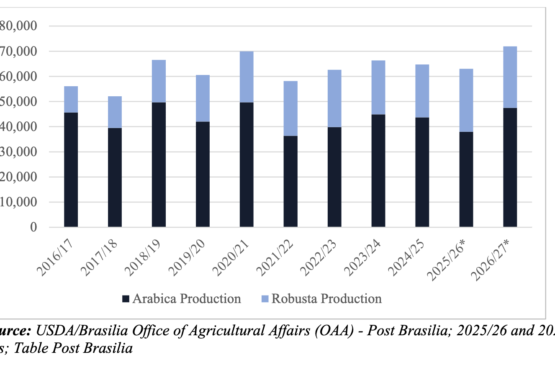
Brazil accounts for roughly one third of the world’s total coffee production and is the largest supplier of Arabica. As such, its harvest directly affects market conditions because it informs global coffee stock positions and determines whether these will meet, surpass, or fall short of expected consumer demand. From a practical point of view, the pace at which coffee is picked, processed and milled is hugely important to us, as it gives us an idea of how the export season will unfold. This information helps us plan the timing of our sourcing trip and the breakdown of each of our containers to ensure we select the best lots and avoid shipment delays.
How is Brazil’s 2026/27 harvest looking?
The 2026 harvest kicked off with high hopes and predictions of a 25% increase in yields of Arabica. This is because rainfall was consistent throughout late 2025 and early 2026, and because cultivation has been steadily expanding following a couple of years of rising market prices. Both factors pointed towards a bountiful year — though expectations have tempered as the harvest has progressed, painting an uncertain picture and introducing volatility into the market, which is why the C price has been so unstable in recent weeks.
Cloudy, rainy weather has slowed down cherry maturation, particularly in two of the country’s most productive regions, Minas Gerais and São Paulo. In Minas Gerais, for example, at the beginning of July, around 40% of the harvest should have been harvested; this year, it had only reached 30%. Nationwide, during that same period, total production lagged by 8%. The since-declared El Niño, and the dry weather it has brought, has helped cherries ripen and parchment dry more quickly; yet by the end of July, when 76% of the country’s harvest had been picked, it was still behind schedule.
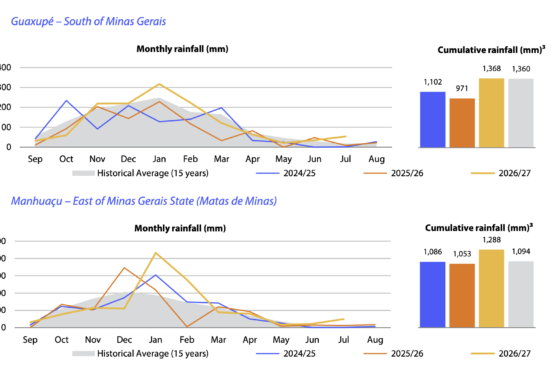
In the short-term, this means actual supply is yet to catch up to the potential it presented at the beginning of the harvest. Because cherries that drop during heavy rains produce beans of lower quality, there is also a possibility that affected regions have insufficient amounts of high-quality coffee available. In the longer term, there are creeping concerns that the dry weather that helped producers regain lost grounds this year will lead to lower yields across Brazil during its 2027/28 harvest. This is because, if El Niño delays crucial rains this September and October, when trees are flowering, cherry production will be hindered.
Additionally, the country’s currency, the Brazilian Real, is experiencing a particularly good year against the US Dollar, disincentivising producers from selling their crop right away and creating a further perceived shortage of stock. This is because production costs and living expenses are paid in Reais rather than USD, and when the Real is strong, producers receive fewer of them per kilo of coffee sold. When the currency weakens, producers and exporters try to sell their crop quickly because they receive more Reais per kilo of coffee sold, immediately increasing the amount of physical stock available in the market. Even though the Brazilian Real is expected to weaken later in the year, its current position is stoking fears that this year’s yields will not meet early predictions — but these apparent low stock levels could simply be caused by producers who are waiting until they can earn more money for their coffee.
How are our producing partners faring this year?
At MCM, all of our Brazilian offerings come from Bahia’s Chapada Diamantina region and here the harvest starts slightly later in the year due to its latitude position, elevation and climate. The state of Bahia is the country’s fourth largest producer, however, the farms located near the towns of Piatã and Mucugê, where some of the country’s finest coffee is grown (and all our Brazilians are sourced), only contribute to a small percentage of that volume. As such, their harvests’ nuances often get missed from the updates and reports delivered by analysts and speculators.
While last year, production in Chapada Diamantina was much lower than the average in Brazil, the 2026/27 harvest is looking like a bumper crop. Because their focus is specialty coffee, our supply partners are also taking advantage of the extra time the cloudy weather has afforded them to produce the very best lots they can. Our supply partner Silvio Leite is thrilled with the effects of this season’s pace. Because of it, some cherries “have had more than 280 days of development after flowering,” he told us, “Which is exceptional and should contribute to remarkable cup quality.” Since Silvio also connects us to a network of producers across Piatã, with whom he’s in constant contact during the harvest, hearing such reassuring reports is very exciting. For Silvio, who has long been a proponent of slowing down fruit development by introducing shade trees and coffee drying by using patios and raised beds in covered greenhouses, this year’s weather conditions have been pretty close to perfect.
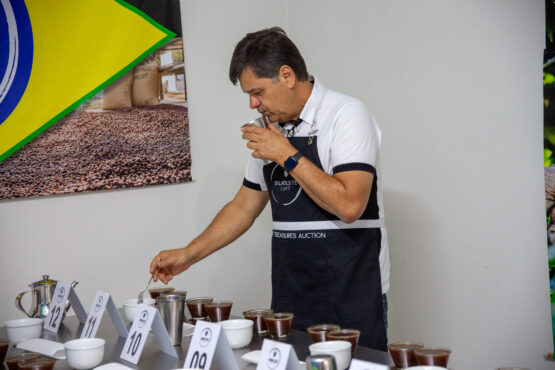
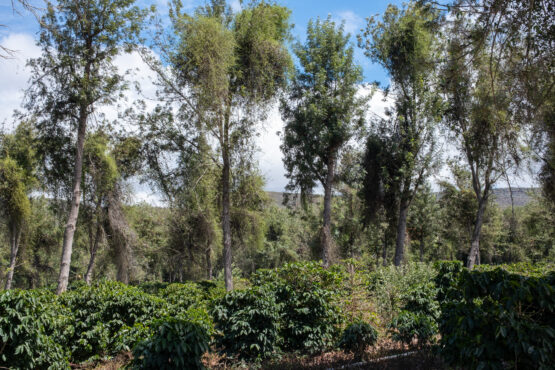
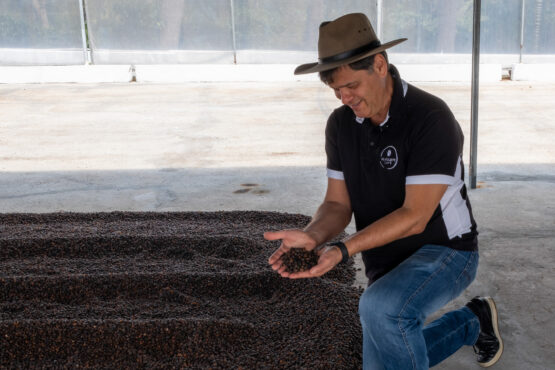
The season has not been without its complexities, however. Rising costs due to labour shortages, inflation, and the need to upgrade plantations and irrigation systems to survive the country’s changing climate is something that is felt by all of the producers we work with. “One of our biggest challenges is finding enough people for the harvest. Every year this becomes a little more difficult,” Silvio explained. Cherry selection is predominantly done by hand in Piatã, as most of these properties’ coffee plantations are under 20 hectares in size, a tiny amount in a country known for estates that extend over hundreds of hectares and can afford mechanized harvesting. Still, the hope is that such a lengthy period of cherry maturation and extra careful picking and processing will lead to more complex, distinct lots across the board — the type that catapulted the region to fame.
At the Borré family’s Fazenda Progresso, in neighbouring Mucugê, the slower pace is also expected to be beneficial for quality, though it has meant they’re slightly behind their usual schedule. Because they’re a much larger estate than those we source from in Piatã, delays can cause headaches down the line when export season begins. To avoid this, our goal is to be decisive with our selection during this year’s trip, to ensure our shipments move swiftly. So far, we’ve heard reports of good volumes and excellent evaluation scores, which will make the task easier to manage. Overall, as Silvio put it, “The coffees we have cupped so far are showing very nice quality and the typical characteristics of our terroir: good clarity, refined and balanced acidity, creamy body, with notes of chocolate, vanilla and passion fruit. We are very happy with what we are seeing and working hard to take good care of every lot.”
Due to the complexities of each harvest in Chapada Diamantina, our buying strategy here has always been to confirm prices ahead of the season, taking into account the cost of production, exchange rate and availability, as part of the mutually beneficial relationship we have with our supply partners. While the international market does have an influence on this figure, as it does everywhere, it does not guide our practices. It also means that once the price is set, it’s final — it only changes if we shift our own margins, rather than our supply partners’.
What should you expect from our Brazilian offerings this year?
Our goal, like every season, is to begin shipping coffees as soon as they’re physically available. A constant supply of blending lines is key to our business and roasting partners, and we hope to start landing our larger volume pulped natural lots from Fazenda Progresso as early as October. When selecting these, we’ll focus on finding clean, sweet, high quality lots that represent excellent value and offer consistency and stability year-round.
Microlots from Fazenda Progresso, like Airumá, Sincorá and Gandula, should arrive from January onwards, along with coffees from Silvio Leite’s Cerca de Pedras farm (which include microlots from his Sakura and São Benedito plots). We will also be landing coffees from the small farms we work with in Piatã, including Sítio Canaã, São Judas, Cafundó and Santa Barbara. When selecting these special lots we’ll look for distinct, stand out offerings that showcase a taste of place and that make great espresso or filter offerings.
Keen to order Brazils this year?
Letting us know your buying intentions early in the season is key in securing your favourite coffees — simply reach out to book a planning session with our expert team!